
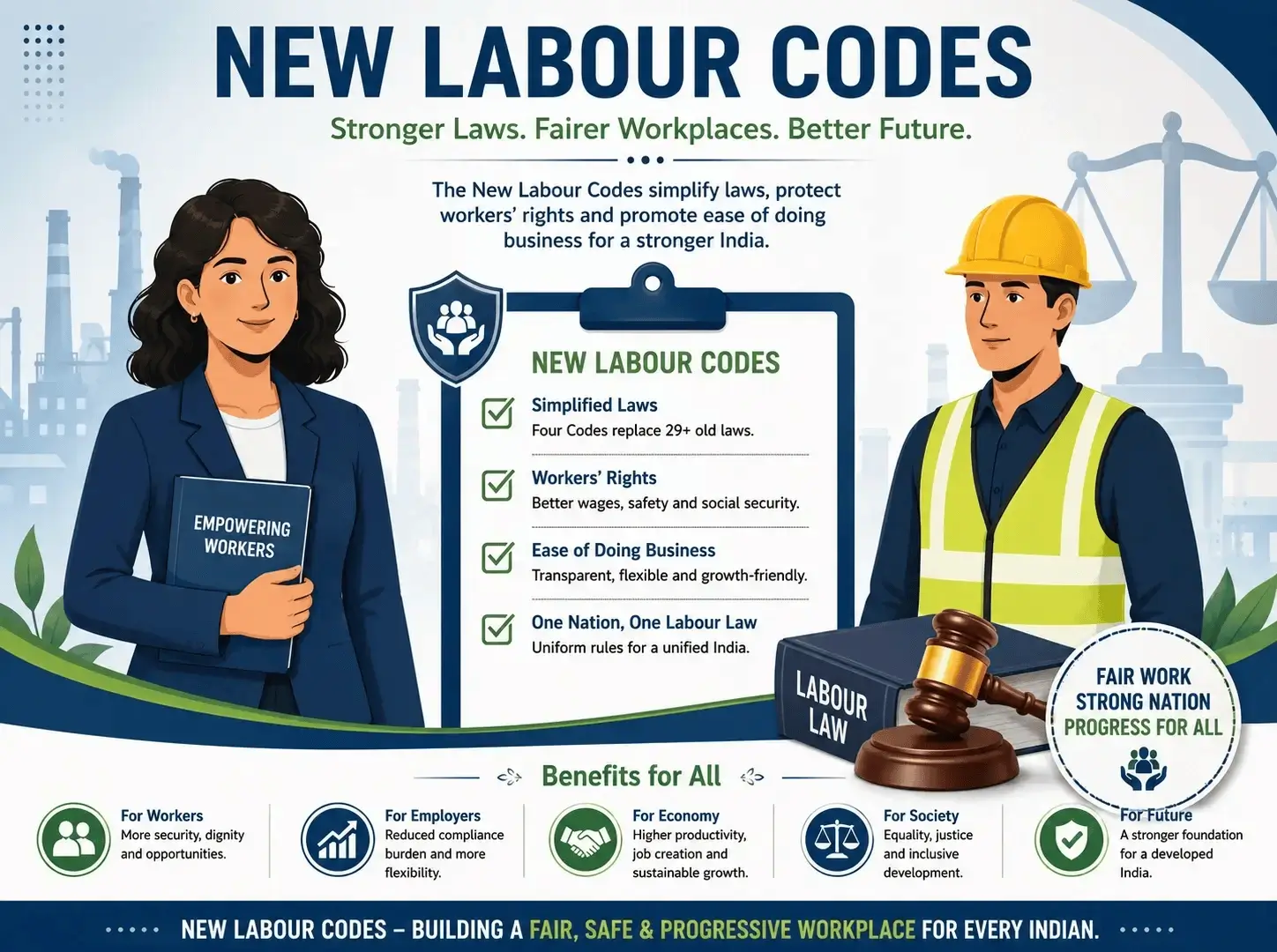
India’s labour laws have undergone one of the biggest reforms in recent years through the introduction of the New Labour Codes. The Government of India consolidated 29 existing labour laws into four simplified labour codes to improve ease of doing business, increase transparency, and provide better protection to workers. These reforms aim to modernize India’s labour system according to the needs of the 21st-century economy.
The four labour codes are:
- Code on Wages, 2019
- Industrial Relations Code, 2020
- Occupational Safety, Health and Working Conditions Code, 2020
- Code on Social Security, 2020
These labour codes are expected to impact employers, employees, industries, and the overall economy. While some people see them as progressive reforms, others believe they may reduce worker protections. Therefore, understanding the new labour codes is important for students, workers, and businesses alike.
Objectives of the New Labour Codes
The Indian government introduced the new labour codes with several key objectives:
- To simplify and consolidate complex labour laws
- To reduce legal confusion and compliance burden
- To improve working conditions for employees
- To encourage formal employment
- To attract domestic and foreign investment
- To ensure social security benefits for more workers
- To create a balance between workers’ rights and industrial growth
Earlier, different labour laws had overlapping definitions and rules, which created confusion for both employers and workers. The new labour codes aim to provide a single, unified framework.
1. Code on Wages, 2019
The Code on Wages combines four earlier laws related to wages and bonuses. It applies to all employees in organized and unorganized sectors. Here are the main features:
Universal Minimum Wage
The government can fix a minimum wage for all types of employment. Earlier, minimum wages applied only to certain scheduled employments.
Timely Payment of Wages
The code ensures that workers receive wages on time without unnecessary delays.
Equal Remuneration
Men and women must receive equal pay for equal work. Gender-based wage discrimination is prohibited.
Floor Wage
The central government may set a national floor wage, and states cannot fix wages below this level.
Importance
This code aims to protect workers from exploitation and ensure fair wages. It is especially beneficial for workers in the unorganized sector.
2. Industrial Relations Code, 2020
The Industrial Relations Code deals with trade unions, dispute resolution, layoffs, and industrial relations. Have a look these main features:
Recognition of Trade Unions
A trade union with at least 51% support in an establishment can be recognized as the negotiating union.
Strikes and Lockouts
Workers must give prior notice before going on strike. Employers must also follow procedures before lockouts.
Standing Orders
Companies with 300 or more workers are required to prepare standing orders regarding working conditions and employee behavior.
Layoffs and Retrenchment
Firms with fewer than 300 workers can lay off employees without prior government permission. Earlier, this limit was 100 workers.
Importance
The code aims to improve industrial peace and make business operations more flexible. However, some labour unions fear that it may weaken workers’ bargaining power.
3. Occupational Safety, Health and Working Conditions Code, 2020
This code focuses on workplace safety, employee health, and working conditions. It combines 13 existing labour laws.
Safe Working Environment
Employers are responsible for maintaining safety, hygiene, and proper working conditions.
Working Hours
The government may prescribe maximum working hours. Employees are entitled to weekly holidays and leave benefits.
Annual Health Check-Ups
Certain workers are entitled to free annual medical examinations.
Welfare Facilities
Employers must provide facilities such as drinking water, canteens, first aid, and restrooms.
Protection for Women Workers
Women can work during night shifts with their consent and under safety conditions.
Importance
This code improves worker welfare and ensures safer workplaces, especially in factories, mines, and construction sectors.
4. Code on Social Security, 2020
The Code on Social Security aims to extend social security benefits to more workers, including gig and platform workers.
Coverage of Gig Workers
Workers associated with online platforms such as food delivery and ride-sharing services may receive social security benefits.
Provident Fund and Insurance
The code includes provisions for provident fund, gratuity, maternity benefits, and employee insurance.
Fixed-Term Employment
Fixed-term employees become eligible for gratuity benefits without completing five years of service.
Social Security Schemes
The government can introduce welfare schemes for unorganized workers, gig workers, and platform workers.
Importance
This code is considered significant because it recognizes new forms of employment emerging in the digital economy.
Advantages of the New Labour Codes
Simplification of Laws
Earlier, India had many complicated labour laws with different definitions and compliance rules. The new system reduces complexity and improves clarity.
Ease of Doing Business
Simplified laws may encourage businesses to expand operations and generate employment opportunities.
Increased Formalization
The labour codes may encourage companies to register workers formally, helping employees receive legal protections and social security benefits.
Better Worker Welfare
Provisions related to safety, wages, medical benefits, and social security can improve workers’ quality of life.
Inclusion of Gig Workers
For the first time, gig and platform workers are being included in the social security framework.
Criticism and Challenges
Despite several benefits, the new labour codes have also faced criticism from trade unions and labour organizations.
Fear of Reduced Worker Rights
Some unions believe that easier layoffs and restrictions on strikes may reduce workers’ bargaining power.
Implementation Challenges
Labour is a concurrent subject, meaning both central and state governments are involved. Effective implementation requires coordination among states.
Lack of Awareness
Many workers, especially in the unorganized sector, are still unaware of their rights under the new codes.
Concerns Over Job Security
Increasing the threshold for government permission during layoffs may create uncertainty among workers in medium-sized companies.
Impact on Employers and Employees
For Employers
- Reduced compliance burden
- Simplified registration and licensing
- Greater flexibility in workforce management
- Easier dispute resolution
For Employees
- Improved wage protection
- Better workplace safety
- Access to social security benefits
- More formal employment opportunities
However, employees may also face concerns regarding job security and union power.
Future of Labour Reforms in India
The success of the new labour codes depends on proper implementation and cooperation among governments, industries, and workers. Clear rules, digital systems, awareness campaigns, and effective grievance mechanisms will play a major role in achieving the objectives of these reforms.
India’s economy is rapidly changing with the growth of technology, startups, and the gig economy. Therefore, labour reforms are necessary to meet modern employment needs while protecting workers’ rights.
Conclusion
The new labour codes represent a major step toward modernizing India’s labour system. By consolidating numerous laws into four simplified codes, the government aims to improve efficiency, promote industrial growth, and ensure better protection for workers. These reforms seek to balance economic development with employee welfare.
While the labour codes offer many advantages such as simplified regulations, improved social security, and better workplace safety, they also raise concerns about job security and workers’ rights. Their true success will depend on fair implementation, strong enforcement, and continuous dialogue between employers and employees.
Overall, the new labour codes have the potential to reshape India’s workforce and contribute significantly to the country’s economic growth and development.